Leasing vs. Buying a Car in 2025: Your 3-Year Guide
Understanding the financial implications of leasing versus buying a car in 2025 is crucial for making an informed decision, especially when planning for a 3-year ownership period amidst a dynamic automotive landscape.
Deciding between leasing and buying a car is more complex than ever in 2025. With evolving market conditions, interest rates, and vehicle technologies, understanding which option is best for your unique situation, especially over a 3-year ownership period, is paramount.
Understanding the 2025 Automotive Landscape
The automotive market in 2025 presents a unique set of challenges and opportunities for consumers. Supply chain improvements have somewhat stabilized inventory levels, but demand remains robust, particularly for electric vehicles and advanced technology-equipped cars. Interest rates, while fluctuating, are still a significant factor in financing decisions, making the comparison between leasing and buying even more critical.
This section delves into the macro-economic factors influencing car acquisition in the current year. Understanding these broader trends is the first step in making an informed personal financial decision. From manufacturing shifts to consumer preferences, every element plays a role in the overall cost of vehicle ownership.
Current Market Dynamics Affecting Car Costs
- Interest Rate Environment: Higher interest rates generally increase the total cost of car loans, making buying more expensive.
- Vehicle Inventory: While improving, specific models or trims might still experience limited availability, impacting pricing and negotiation power.
- Technological Advancements: Rapid advancements in EV technology and autonomous features can accelerate depreciation for older models, a key factor in leasing.
The interplay of these factors means that a decision made today could have significant financial ramifications over a three-year span. It’s not just about the sticker price anymore; it’s about the total cost of ownership in a rapidly changing market. Therefore, a thorough evaluation of both leasing and buying scenarios is essential before committing to a vehicle.
The Fundamentals of Car Leasing for a 3-Year Term
Leasing a car essentially means you are paying for the depreciation of the vehicle over a set period, typically 24 to 48 months. For a 3-year ownership period, leasing offers predictability and often lower monthly payments compared to buying. You don’t own the car, but you have exclusive use of it for the lease term.
This option appeals to drivers who enjoy driving new cars frequently and prefer to avoid the long-term commitment of ownership. It simplifies the process of getting into a new vehicle every few years, complete with the latest features and warranty coverage. However, understanding the nuances of a lease agreement is vital before signing any paperwork.
Key Components of a Lease Agreement
A lease agreement involves several critical financial elements that determine your monthly payments and overall cost. These include the capitalized cost, residual value, money factor, and mileage allowance. Each component needs careful consideration to ensure the lease aligns with your financial goals and driving habits.
- Capitalized Cost: This is essentially the selling price of the car, which can be negotiated just like a purchase price. A lower capitalized cost means lower monthly payments.
- Residual Value: The estimated value of the car at the end of the lease term. A higher residual value is beneficial for the lessee, as it reduces the depreciation you pay for.
- Money Factor: This is the equivalent of an interest rate for a lease. A lower money factor means less interest paid over the lease term.
- Mileage Allowance: Leases come with strict annual mileage limits (e.g., 10,000-15,000 miles). Exceeding this limit incurs significant per-mile penalties.
Understanding these terms is crucial for anyone considering a lease. Negotiating the capitalized cost and being mindful of the money factor can significantly impact your monthly outlay. Furthermore, accurately estimating your annual mileage is perhaps one of the most critical steps to avoid unexpected charges at the end of the lease term. A three-year lease commitment demands foresight into your driving needs.
The Fundamentals of Car Buying for a 3-Year Term
Buying a car, whether new or used, means you take full ownership of the vehicle from day one. For a 3-year ownership period, this typically involves taking out a car loan and making monthly payments until the loan is paid off. At the end of three years, you’ll still own the car, though its value will have depreciated.
This option provides complete freedom regarding mileage, modifications, and eventual resale or trade-in. It’s often seen as a long-term investment, even with depreciation, as you build equity in an asset. However, the initial costs and ongoing responsibilities are generally higher than with leasing.
Financial Considerations When Buying
When purchasing a vehicle, several financial aspects come into play beyond just the purchase price. These include down payments, interest rates on loans, sales tax, and ongoing maintenance costs. These elements collectively determine the true cost of ownership over a three-year period.
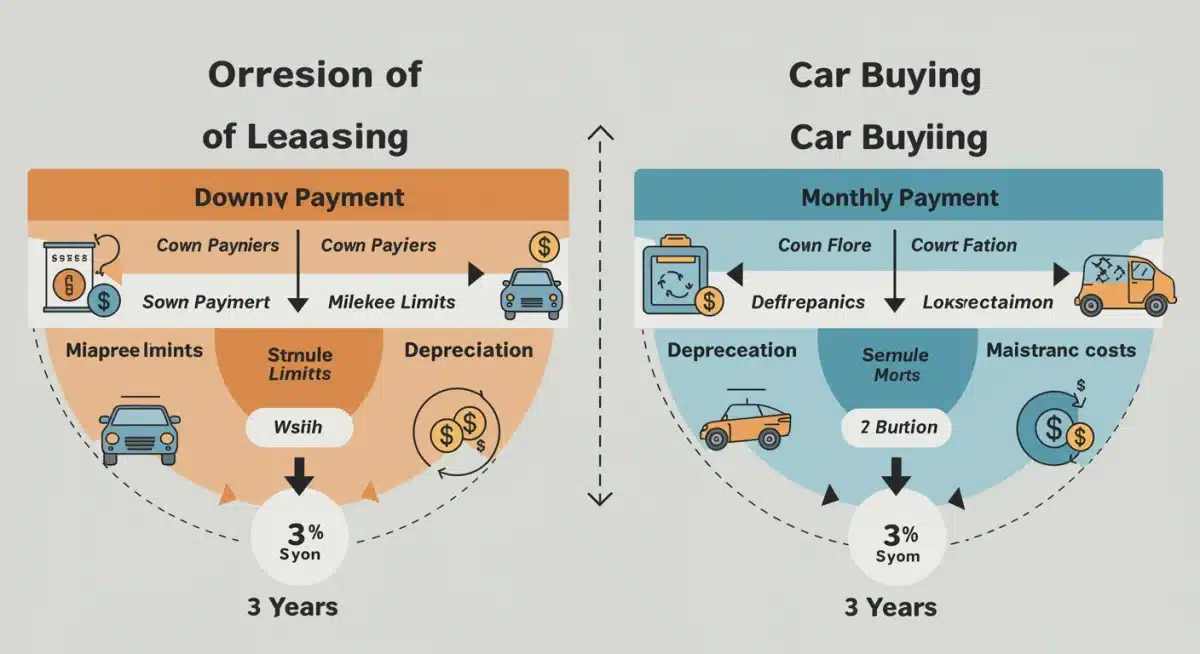
- Down Payment: A larger down payment reduces the loan amount, leading to lower monthly payments and less interest paid over the loan term.
- Interest Rate: Your credit score significantly impacts the interest rate you qualify for, directly affecting the total cost of the loan.
- Depreciation: Cars lose value significantly in their first few years. While you own the car, this loss in value is a real cost of ownership.
- Maintenance and Repairs: As an owner, you are responsible for all maintenance and repairs once the factory warranty expires, which can happen within a 3-year period.
Evaluating these factors is essential for anyone looking to buy. While you gain equity, you also bear the full burden of depreciation and maintenance. It’s a trade-off between control and responsibility, and for a 3-year timeframe, the depreciation hit can be quite substantial, requiring careful financial planning.
Depreciation and Resale Value: A 3-Year Perspective
Depreciation is arguably the largest and most overlooked cost of vehicle ownership, particularly within a 3-year ownership period. For leased vehicles, depreciation is the core of your monthly payment. For purchased vehicles, it represents the loss in value of your asset. Understanding how different vehicles depreciate is key to making a smart financial choice.
Generally, a new car loses about 20-30% of its value in the first year and continues to depreciate by 15-20% annually for the next few years. By the end of three years, a car could have lost 40-50% of its initial value. This rapid decline is a major factor differentiating leasing from buying.
Factors Influencing 3-Year Depreciation
Several elements contribute to how quickly a car loses value. Brand reputation, model popularity, reliability, and even color can play a role. Being aware of these factors can help you predict the resale value of a purchased car or the residual value of a leased vehicle.
- Brand and Model Popularity: Certain brands and models hold their value better than others due to demand and reputation.
- Reliability and Maintenance Costs: Vehicles with a strong track record for reliability and lower maintenance costs tend to depreciate less.
- Market Trends: The shift towards electric vehicles, for example, can impact the resale value of gasoline-powered cars over three years.
- Condition and Mileage: The physical condition of the car and the mileage accumulated significantly affect its value at the end of the period.
For a leased vehicle, the residual value is set at the beginning, providing a clear expectation of its worth at lease end. For a purchased vehicle, the actual resale value can be less predictable, depending on market conditions and the car’s condition. This uncertainty is a risk assumed by the buyer, not the lessee.
Calculating Your Best Option: Lease vs. Buy in 2025
Making the right decision between leasing and buying for a 3-year ownership period requires a personalized calculation. There isn’t a one-size-fits-all answer, as your driving habits, financial situation, and priorities all play a crucial role. This section will guide you through the key calculations and considerations.
Start by outlining your estimated annual mileage, your desired down payment, and your credit score. These are foundational elements that will heavily influence the financial outcomes of both leasing and buying. Also, consider how long you typically keep a car and your preference for new technology.
Comparing the Costs: A Step-by-Step Approach
To effectively compare, create a side-by-side analysis of the total costs for both options over three years. This involves more than just monthly payments; it includes upfront costs, insurance, maintenance, and the equity (or lack thereof) at the end of the term.
- Upfront Costs: Compare down payments, first month’s payment, security deposit (for leases), taxes, and fees for both scenarios.
- Monthly Payments: Calculate the total monthly payments over 36 months for both a lease and a loan.
- Insurance Costs: Leased vehicles often require higher insurance coverage, so factor this into your comparison.
- Maintenance & Repairs: For purchased vehicles, estimate potential out-of-warranty repairs. Leased vehicles are typically covered by warranty for three years.
- End-of-Term Costs: For leases, consider disposition fees and potential excess mileage or wear-and-tear charges. For purchased cars, estimate the resale value to determine your net cost.
By meticulously detailing these costs, you can gain a clear picture of the financial implications of each choice. Remember to also account for the opportunity cost of your down payment. The goal is to find the option that aligns best with your budget and lifestyle without any hidden surprises.
Lifestyle and Flexibility: Beyond the Numbers
While financial calculations are paramount, the decision between leasing and buying for a 3-year ownership period also hinges on lifestyle and personal preferences. Your driving habits, desire for new technology, and tolerance for vehicle maintenance all play a significant role in determining the ‘best’ option for you. It’s about finding the balance between financial prudence and personal convenience.
Consider how much you value driving a new car every few years versus the pride of owning an asset. Think about your average commute and whether you anticipate any significant changes in your driving needs over the next three years. These non-monetary factors can often sway the decision even when the financial costs are similar.
Personal Preferences and Practicalities
Different individuals prioritize different aspects of car ownership. Some value consistency and long-term investment, while others prefer the flexibility and novelty of frequent vehicle changes. Understanding your own priorities will help clarify which path is more suitable.
- Desire for New Features: If you enjoy having the latest technology and safety features, leasing allows you to upgrade more frequently.
- Mileage Habits: High-mileage drivers (over 15,000 miles/year) will almost always find buying more cost-effective due to lease penalties.
- Vehicle Customization: Buyers have complete freedom to customize their vehicles, whereas lessees are restricted to factory specifications.
- Maintenance Responsibility: Leased cars are typically under warranty for the entire 3-year term, minimizing repair costs. Buyers assume all maintenance responsibility.
- Future Planning: If your job or living situation is uncertain, the flexibility of a lease might be appealing, though breaking a lease can be costly.
The choice extends beyond just saving money; it involves how a vehicle integrates into your daily life and future plans. A leased car offers a predictable, hassle-free driving experience for three years, while buying offers the long-term benefit of ownership and equity, albeit with more responsibility. Weighing these qualitative factors alongside the quantitative ones will lead to the most satisfying decision.
The Future of Ownership: What Comes After 3 Years?
Concluding a 3-year ownership period, whether through leasing or buying, brings you to another crossroads. For lessees, the options typically involve returning the car, purchasing it, or leasing a new one. For buyers, the choices are to keep the car, sell it, or trade it in for a new vehicle. Understanding these post-3-year options is crucial for long-term financial planning.
This foresight allows you to make a decision today that sets you up for success three years down the line. The residual value of a lease, for instance, can become an important factor if you decide to buy the car at the end of the term. Similarly, the resale value of a purchased car determines how much equity you’ve retained or lost.
Post-3-Year Scenarios for Lessees and Buyers
The end of your initial 3-year term opens up various possibilities, each with its own financial implications. Planning for these outcomes from the start can prevent surprises and ensure a smooth transition to your next vehicle.
- Lease Return: The simplest option; you return the car and walk away, assuming no excess wear or mileage.
- Lease Buyout: You can purchase the leased vehicle at its predetermined residual value. This can be advantageous if the market value is higher than the residual.
- Trade-in (Buyer): If you bought, you can use your car’s equity as a down payment on your next purchase.
- Private Sale (Buyer): Selling your car privately might yield a higher price than a trade-in but requires more effort.
- Keeping the Car (Buyer): Continue driving your paid-off vehicle, enjoying lower monthly costs, but preparing for increased maintenance as it ages.
Each of these paths has distinct financial and practical considerations. Lessees have the advantage of a clear exit strategy, while buyers have more flexibility if they want to retain the vehicle for longer or leverage its equity. Your initial decision should ideally align with your anticipated actions three years later.
| Key Aspect | Description for 3-Year Period |
|---|---|
| Monthly Payments | Leasing often means lower monthly payments due to paying only for depreciation. Buying involves loan repayment, typically higher. |
| Ownership & Equity | Buying builds equity, though offset by depreciation. Leasing offers no ownership equity at the end of the term. |
| Flexibility & Mileage | Buying offers unlimited mileage and customization. Leasing has strict mileage limits and wear-and-tear clauses. |
| Maintenance Costs | Leased vehicles are typically under warranty for the 3-year term. Buyers are responsible for all maintenance and out-of-warranty repairs. |
Frequently Asked Questions About Car Ownership in 2025
Generally, no. Leases come with strict mileage limits, typically 10,000-15,000 miles per year. Exceeding these limits can result in significant per-mile penalties at the end of the lease, making buying a more cost-effective option for high-mileage drivers.
A good credit score is beneficial for both. For buying, it secures lower interest rates on loans. For leasing, it typically leads to a lower ‘money factor,’ which is essentially the interest rate on the lease, resulting in lower monthly payments.
Terminating a lease early can be very expensive. Most lease agreements include substantial early termination fees, which might include the remaining payments, penalties, and other charges. It’s generally advised to fulfill the entire lease term.
While some stabilization is expected, car prices in 2025 are likely to remain elevated compared to pre-pandemic levels due to ongoing demand, technological integration, and production costs. However, individual model prices will fluctuate based on supply and demand dynamics.
Buying a used car can be a more economical choice over three years, particularly if you want to avoid depreciation of new vehicles and gain full ownership. However, you might face higher maintenance costs and won’t have the latest features of a new leased car.
Conclusion: Making Your Informed Decision for 2025
Ultimately, the choice between leasing and buying a car for a 3-year ownership period in 2025 is a deeply personal one, influenced by a myriad of financial, practical, and lifestyle factors. There is no universally ‘better’ option; rather, it’s about identifying the strategy that best aligns with your individual circumstances. By meticulously evaluating the costs, understanding the market dynamics, and considering your driving habits and future plans, you can confidently select the path that offers the most value and satisfaction for your automotive needs in the coming years. An informed decision today will set the stage for a positive ownership experience tomorrow.