Wireless EV Charging in US: 90% Efficiency by 2025
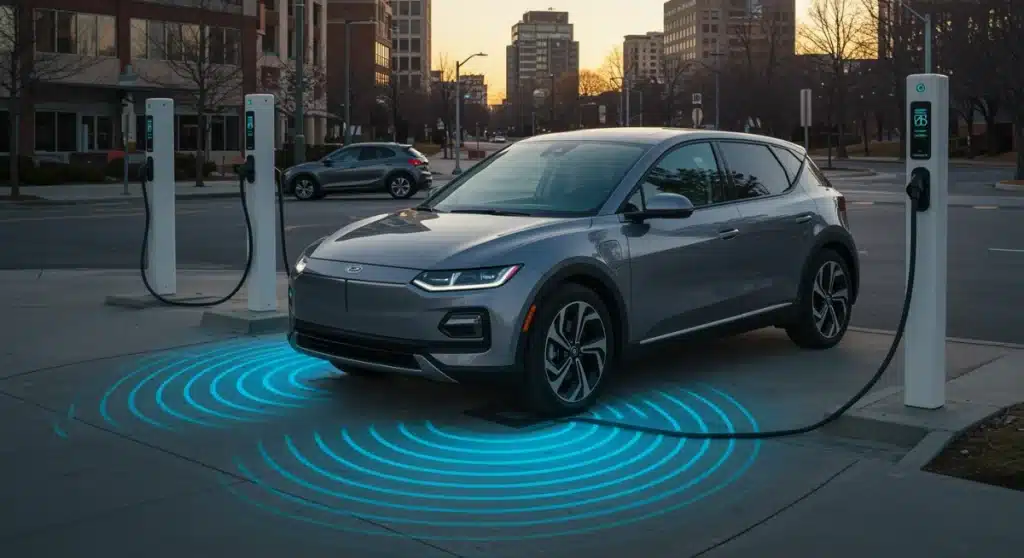
The future of wireless EV charging in the US is rapidly advancing, with pilot programs projected to achieve 90% efficiency by late 2025, promising a seamless and transformative experience for electric vehicle owners.
Imagine a world where charging your electric vehicle is as simple as parking. No cables, no fuss, just effortless power transfer. This isn’t a distant dream; it’s the near future, as the future of wireless EV charging in the US: pilot programs showing 90% efficiency by late 2025 are rapidly making this a reality. This revolutionary technology promises to redefine convenience and accelerate the adoption of electric vehicles across the nation.
The dawn of wireless EV charging technology
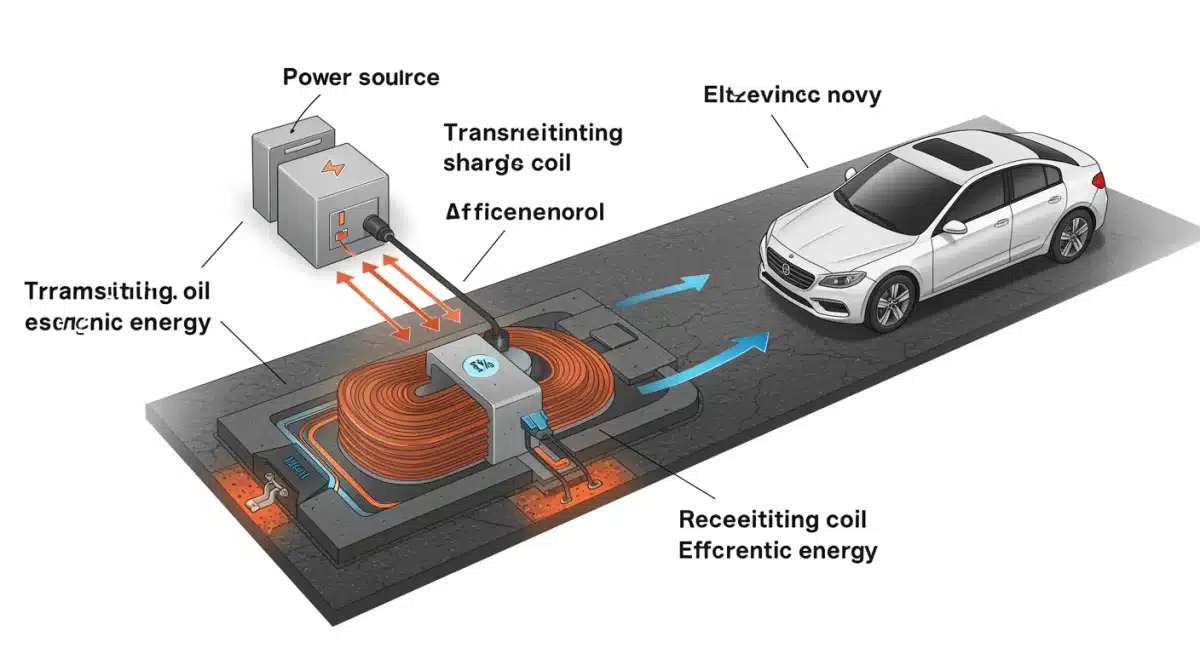
Wireless electric vehicle (EV) charging, also known as inductive charging, represents a significant leap forward from conventional plug-in methods. This technology operates on the principle of electromagnetic induction, allowing energy to be transferred between two coils without physical contact. One coil is embedded in the ground, typically in a parking spot or road, while the other is mounted on the underside of the EV.
The concept itself isn’t entirely new, but its application to electric vehicles at scale, with high efficiency, marks a pivotal moment. Early iterations faced challenges related to efficiency losses and alignment issues, which limited their widespread adoption. However, ongoing research and development, particularly within US pilot programs, have made substantial strides in overcoming these hurdles, pushing the technology closer to commercial viability.
How inductive charging works
Inductive charging relies on two primary components: a transmitting coil and a receiving coil. When an alternating current flows through the transmitting coil, it generates an oscillating magnetic field. If a receiving coil is brought within this magnetic field, it induces an electric current in the receiving coil, which is then used to charge the vehicle’s battery. This process is seamless and occurs automatically when the vehicle is positioned correctly over the charging pad.
- Transmitting coil: Embedded in the ground, connected to the power grid.
- Receiving coil: Mounted on the EV’s undercarriage, converts magnetic energy to electricity.
- Magnetic field: The medium for energy transfer, generated by alternating current.
- Efficiency: Measured by the ratio of energy delivered to the battery versus energy drawn from the grid.
The evolution of this technology has been driven by the need for more convenient, robust, and aesthetically pleasing charging solutions. As the number of EVs on the road continues to grow, the demand for accessible and user-friendly charging infrastructure becomes paramount. Wireless charging offers a solution that minimizes clutter, eliminates trip hazards, and can be integrated seamlessly into urban and suburban environments.
Current landscape of wireless EV charging in the US
The United States is currently a hotbed of innovation for wireless EV charging, with numerous pilot programs underway across various states. These initiatives involve collaborations between automotive manufacturers, energy companies, technology developers, and government agencies, all working towards refining the technology and establishing industry standards. The goal is to move beyond laboratory testing and prove the technology’s effectiveness in real-world scenarios.
Many of these pilot programs focus on different applications, from static charging in parking spaces to dynamic charging on roadways. Static wireless charging is being tested in public parking lots, private garages, and even at taxi stands, offering a convenient way for vehicles to top up their batteries while stationary. Dynamic charging, though more complex, holds the promise of charging vehicles while they are in motion, potentially eliminating range anxiety altogether.
Key players and initiatives
Several prominent organizations are leading the charge in the US. Companies like WiTricity, a spin-off from MIT, are at the forefront of developing and licensing wireless charging technology. Automakers such as BMW and Mercedes-Benz have already experimented with integrating wireless charging capabilities into some of their EV models for testing purposes. Furthermore, government-funded projects are exploring the feasibility of deploying this technology in public infrastructure.
- WiTricity: A leader in magnetic resonance technology for wireless power transfer.
- Major automakers: Integrating and testing wireless charging in new EV platforms.
- Department of Energy (DOE): Funding research and development for advanced charging solutions.
- Utility companies: Exploring grid integration and deployment strategies.
These pilot programs are not just about proving technical feasibility; they are also crucial for understanding user experience, regulatory implications, and economic viability. Data collected from these trials will inform future design improvements, policy decisions, and ultimately, the commercial rollout of wireless charging solutions across the nation. The insights gained are invaluable for shaping the next generation of EV infrastructure.
Breaking the 90% efficiency barrier by late 2025
One of the most exciting developments in the realm of wireless EV charging is the projected achievement of 90% efficiency by late 2025. This milestone is critical because efficiency directly impacts the practicality and environmental benefits of the technology. Lower efficiency means more energy loss, higher electricity bills, and a larger carbon footprint, negating some of the advantages of EVs.
Achieving 90% efficiency brings wireless charging firmly into competitive territory with traditional plug-in chargers, which typically offer efficiencies between 85% and 95%. This improved efficiency is a result of advancements in coil design, power electronics, alignment systems, and sophisticated control algorithms that optimize energy transfer. Researchers are continuously refining these components to minimize losses and maximize power delivery.
The push for higher efficiency is not just an engineering challenge but also an economic imperative. As efficiency increases, the cost of charging decreases for consumers, making EVs even more attractive. Moreover, higher efficiency reduces the strain on the electrical grid, as less power is wasted during the charging process. This makes wireless charging a more sustainable and scalable solution for the growing EV market.
Technological innovations driving efficiency
Several key technological advancements are contributing to this efficiency breakthrough. These include:
- Advanced coil geometries: Optimizing the shape and size of coils to enhance magnetic coupling.
- Improved power electronics: More efficient inverters and converters to minimize energy conversion losses.
- Precision alignment systems: Using sensors and communication protocols to ensure optimal vehicle positioning over the charging pad.
- Dynamic power adjustment: Systems that can adapt power output based on real-time conditions and battery state.
By late 2025, the consolidation of these innovations is expected to yield consistently high efficiency rates in operational pilot programs. This will provide the necessary data and confidence for broader commercial deployment, paving the way for wireless charging to become a mainstream feature of EV ownership. The implications for convenience and infrastructure development are profound.
Impact on EV infrastructure and user experience
The widespread adoption of wireless EV charging will fundamentally transform the existing EV infrastructure and significantly enhance the user experience. Imagine public parking spaces, taxi stands, and even traffic lights equipped with discreet charging pads, allowing vehicles to charge passively while parked or idling. This seamless integration could make range anxiety a relic of the past.
For urban environments, wireless charging offers a cleaner, less cluttered solution compared to numerous visible charging stations and tangled cables. It also provides a more equitable charging experience for all drivers, including those with disabilities, by eliminating the need for physical manipulation of heavy cables. This inclusive design aspect is a significant benefit that often goes overlooked.
Revolutionizing charging habits
Wireless charging could shift charging habits from scheduled, dedicated stops to opportunistic, continuous top-ups. Instead of waiting for a full charge, drivers could gain small amounts of energy throughout the day, ensuring their battery levels remain consistently high. This ‘graze charging’ model could reduce demand peaks on the grid and optimize energy distribution.
Consider the benefits for:
- Public transport: Buses and shuttles could charge at termini or while paused at stops.
- Commercial fleets: Delivery vans and ride-share vehicles could charge during loading/unloading or waiting periods.
- Private vehicles: Convenient home charging without the need for garage wiring or outdoor outlets.
Beyond convenience, wireless charging can also contribute to a more resilient and smart grid. With bidirectional charging capabilities, EVs could not only draw power but also feed excess energy back to the grid during peak demand, acting as mobile energy storage units. This potential for vehicle-to-grid (V2G) integration adds another layer of value to wireless charging infrastructure.
Challenges and considerations for widespread adoption
Despite the promising advancements, several challenges must be addressed before wireless EV charging achieves widespread adoption across the US. These include standardization, cost, infrastructure deployment, and public perception. Overcoming these hurdles will require concerted efforts from industry, government, and consumers.
Standardization is crucial to ensure interoperability between different EV models and charging systems. Without common standards, consumers might face compatibility issues, limiting the appeal of the technology. Organizations like SAE International are working on developing these standards, but the process is complex and time-consuming, requiring consensus among various stakeholders.
Overcoming technical and economic barriers
The initial cost of installing wireless charging infrastructure can be higher than traditional wired solutions, particularly for ground-embedded pads. This cost factor needs to be balanced against the long-term benefits of convenience and efficiency. Economies of scale, as production ramps up, are expected to bring costs down, but initial investment remains a significant consideration.
- Cost of installation: Higher upfront costs for ground-embedded coils and vehicle modifications.
- Standardization: Ensuring compatibility across different manufacturers and systems.
- Infrastructure scaling: Challenges in deploying widespread charging pads in diverse environments.
- Regulatory hurdles: Navigating permits, safety regulations, and interoperability mandates.
Public perception and education also play a vital role. Consumers need to understand the safety, efficiency, and benefits of wireless charging to embrace it fully. Addressing concerns about electromagnetic fields and ease of use will be essential for building trust and encouraging adoption. Clear communication about the technology’s safety and reliability will be key to its success.
The road ahead: policy, investment, and future outlook
The journey towards a future dominated by wireless EV charging will be shaped by supportive policy, strategic investments, and continuous technological evolution. Government incentives, research grants, and public-private partnerships will be instrumental in accelerating the deployment of this innovative technology across the United States.
Policy frameworks need to be established to facilitate the seamless integration of wireless charging into existing urban planning and energy grids. This includes zoning regulations for charging infrastructure, guidelines for utility connections, and incentives for property owners to install charging pads. A coherent national strategy will be vital to avoid a fragmented rollout.
Strategic investments and public-private partnerships
Significant investment will be required from both the public and private sectors. Private companies will continue to innovate and commercialize wireless charging solutions, while government funding can support large-scale pilot projects and the development of public infrastructure. Collaborative efforts can pool resources and expertise, speeding up the development cycle.
- Government incentives: Tax credits and grants for wireless charging infrastructure.
- Research funding: Continued support for R&D to push efficiency and reduce costs.
- Utility collaboration: Integrating wireless charging into smart grid initiatives.
- Urban planning: Incorporating charging pads into new construction and public spaces.
The future outlook for wireless EV charging in the US is undeniably bright. With pilot programs demonstrating 90% efficiency by late 2025, the technology is poised to move beyond niche applications and become a cornerstone of the EV ecosystem. As challenges are overcome and benefits become more apparent, wireless charging will undoubtedly play a pivotal role in accelerating the transition to sustainable transportation across the nation, making EVs a more attractive and practical option for everyone.
| Key Aspect | Brief Description |
|---|---|
| Efficiency Target | Pilot programs aim for 90% efficiency by late 2025, matching wired charging. |
| Technology Basis | Inductive charging uses electromagnetic fields for contactless power transfer. |
| User Experience | Offers unparalleled convenience, eliminating cables and enabling ‘graze charging’. |
| Key Challenges | Standardization, infrastructure cost, and public perception are main hurdles. |
Frequently asked questions about wireless EV charging
Wireless EV charging, or inductive charging, allows electric vehicles to charge their batteries without physical connection. It uses electromagnetic induction to transfer energy between a charging pad on the ground and a receiving coil on the vehicle, offering a seamless and automatic charging experience.
Current pilot programs are achieving efficiencies close to 90%, making wireless EV charging competitive with traditional wired chargers, which typically range from 85% to 95% efficiency. Advancements in coil design and power electronics are continually improving these figures.
Pilot programs in the US are projected to consistently demonstrate 90% efficiency for wireless EV charging by late 2025. This milestone is crucial for broader commercial deployment and signifies a significant step towards widespread adoption of the technology.
The primary benefits include unparalleled convenience, elimination of charging cables, reduced clutter in public spaces, enhanced accessibility for all users, and the potential for continuous ‘graze charging’ to alleviate range anxiety for EV owners.
Key challenges include establishing universal standards for interoperability, managing the initial installation costs of infrastructure, scaling deployment across diverse environments, and educating the public about the technology’s safety and reliability to foster trust and acceptance.
Conclusion
The trajectory of wireless EV charging in the US is pointing towards a future of remarkable convenience and efficiency. With pilot programs on track to achieve 90% efficiency by late 2025, this technology is poised to revolutionize how electric vehicles are powered, making charging as effortless as parking. While challenges related to standardization and infrastructure costs remain, the clear benefits for user experience and grid integration are driving rapid innovation and investment. As these hurdles are overcome, wireless charging will undoubtedly play a pivotal role in accelerating the transition to sustainable transportation across the nation, making EVs a more attractive and practical option for everyone.