Hydrogen Fuel Cell EVs in US: 2025 Infrastructure Update
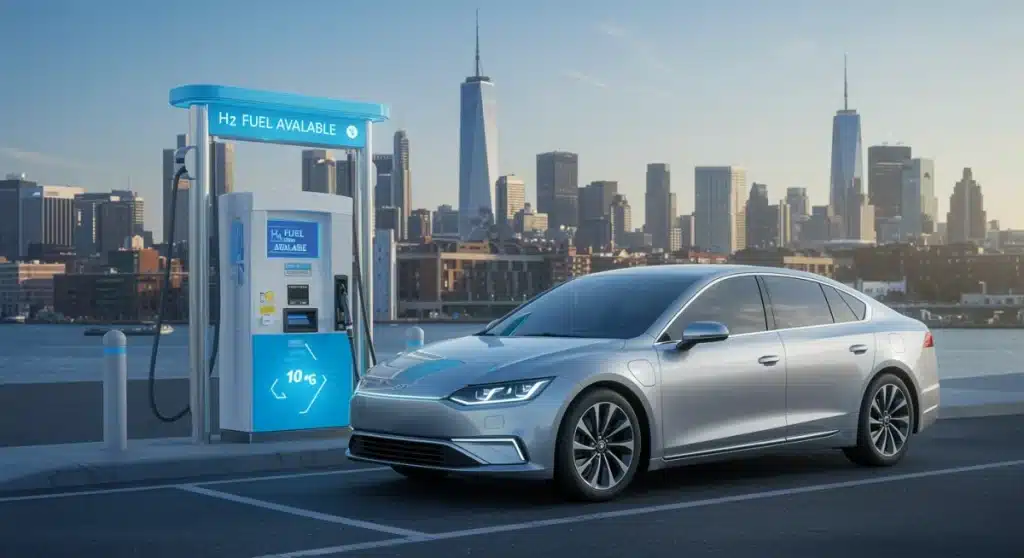
Hydrogen fuel cell EVs represent a promising zero-emission transportation solution, with significant infrastructure expansion and increasing vehicle availability anticipated across the US by 2025, offering a viable alternative to battery electric vehicles.
As we approach 2025, the conversation around sustainable transportation intensifies, with a growing spotlight on hydrogen fuel cell EVs in the US. These innovative vehicles offer a compelling alternative to traditional battery electric vehicles, promising rapid refueling and zero tailpipe emissions. But what does the landscape truly look like for these advanced machines, particularly concerning the crucial elements of infrastructure and availability?
The promise of hydrogen fuel cell EVs
Hydrogen fuel cell electric vehicles (FCEVs) stand at the forefront of automotive innovation, offering a unique blend of environmental responsibility and practical utility. Unlike battery electric vehicles (BEVs) that rely on external charging, FCEVs generate electricity onboard through a chemical reaction between hydrogen and oxygen, producing only water vapor as a byproduct. This fundamental difference underpins their appeal, particularly for drivers seeking quick refueling times and extended ranges.
The core technology involves a fuel cell stack where hydrogen gas from a pressurized tank reacts with air, creating an electric current that powers the vehicle’s electric motor. This process is highly efficient and remarkably clean, contributing significantly to reduced urban air pollution and greenhouse gas emissions. The operational silence and smooth acceleration characteristic of electric powertrains are also inherent to FCEVs, enhancing the driving experience.
Advantages over traditional EVs
When comparing FCEVs to BEVs, several distinct advantages emerge, particularly in scenarios where rapid turnaround and long-distance travel are paramount. While BEV charging times can vary significantly, FCEVs can be refueled in a matter of minutes, a process akin to filling a gasoline tank. This convenience is a major draw for consumers accustomed to conventional fueling methods and for commercial fleets requiring minimal downtime.
- Rapid refueling: FCEVs can be refueled in 3-5 minutes, comparable to gasoline vehicles.
- Extended range: Many FCEVs offer ranges competitive with, or even exceeding, some BEVs and conventional cars.
- Zero emissions: The only byproduct is water vapor, ensuring a clean operation.
- Consistent performance: Fuel cell efficiency is less impacted by extreme temperatures than battery performance.
The promise of hydrogen fuel cell EVs extends beyond individual vehicle benefits. Their adoption could significantly diversify the energy sources for transportation, reducing reliance on fossil fuels and strengthening energy independence. As the technology matures and infrastructure expands, FCEVs are poised to play a crucial role in shaping a more sustainable automotive future, offering a powerful complement to the broader electric vehicle ecosystem.
Current state of hydrogen infrastructure in the US
The development of a robust hydrogen infrastructure is paramount for the widespread adoption of FCEVs in the United States. While significant strides have been made, the current landscape remains concentrated in specific regions, primarily driven by early adoption incentives and strategic investment. California has historically led the charge, establishing a network of refueling stations to support its growing fleet of FCEVs.
As of early 2024, the number of publicly accessible hydrogen stations across the US, though increasing, is still relatively small compared to gasoline stations or even BEV charging points. These stations typically dispense hydrogen at either 700 bar (10,000 psi) or 350 bar (5,000 psi), catering to the specifications of available FCEV models. The operational status and reliability of these stations are continuously improving, addressing initial challenges faced by early adopters.
Regional disparities and growth areas
The distribution of hydrogen refueling infrastructure is far from uniform across the nation. California remains the epicenter, benefiting from state-level mandates and funding initiatives aimed at promoting zero-emission vehicles. However, other states are beginning to explore and invest in hydrogen infrastructure, recognizing its potential for heavy-duty transport and industrial applications, which could indirectly benefit passenger FCEVs.
- California: Dominant in both station count and FCEV adoption.
- Northeast Corridor: Emerging interest and pilot projects in states like New York and Connecticut.
- Pacific Northwest: Modest but growing efforts to establish initial stations.
- Midwest and South: Primarily focused on industrial hydrogen production, with nascent plans for transportation.
The expansion beyond California is crucial for FCEVs to achieve national relevance. This expansion is often tied to federal funding, private sector investment, and collaborative efforts between energy companies, automakers, and government agencies. The current state reflects a foundational phase, with strategic growth expected in corridors connecting major metropolitan areas and along key freight routes. This initial infrastructure, though limited, provides a critical starting point for future growth and increased FCEV accessibility.
Projected infrastructure expansion by 2025
Looking ahead to 2025, the trajectory for hydrogen infrastructure expansion in the US is one of cautious but optimistic growth. While a nationwide network comparable to gasoline stations is still a distant goal, significant regional clusters are expected to solidify and expand. Federal initiatives, such as the Bipartisan Infrastructure Law, have allocated substantial funding towards clean hydrogen hubs and infrastructure development, providing a critical impetus.
Industry projections suggest a notable increase in the number of publicly accessible hydrogen refueling stations, particularly within existing FCEV markets and new strategic corridors. Automakers continue to advocate for and invest in infrastructure, understanding that vehicle sales are intrinsically linked to fuel availability. Energy companies are also ramping up their involvement, integrating hydrogen into their broader clean energy portfolios.
Key drivers of growth
Several factors are converging to accelerate infrastructure development. Government incentives, both federal and state, are playing a pivotal role in de-risking investments for station developers. Technological advancements in hydrogen production, storage, and dispensing are also making stations more cost-effective and efficient to build and operate. Furthermore, the increasing demand for hydrogen in other sectors, such as heavy-duty trucking and industrial applications, creates a larger economic ecosystem that supports infrastructure buildout.
- Government funding: Federal and state grants and incentives for hydrogen projects.
- Technological maturation: Improved efficiency and reduced costs for hydrogen production and dispensing.
- Industry collaboration: Partnerships between automakers, energy providers, and infrastructure companies.
- Heavy-duty transport demand: Growth in hydrogen demand from commercial vehicles creating economies of scale.
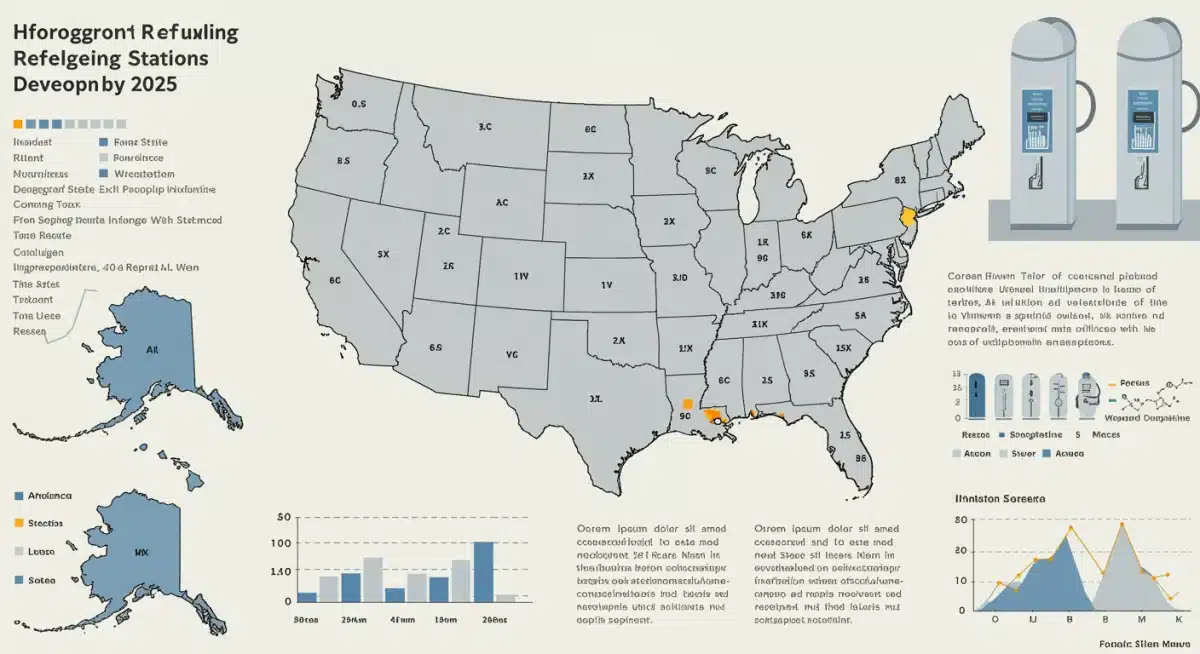
By 2025, we anticipate seeing a more interconnected network of stations in California, with new clusters emerging in key metropolitan areas on the East Coast and potentially in the Pacific Northwest. While still not ubiquitous, this expansion will significantly enhance the viability of FCEVs for a broader segment of the population and commercial users. The focus will likely remain on high-traffic areas and major transportation routes to maximize utilization and demonstrate the technology’s effectiveness.
Availability of hydrogen fuel cell EV models in 2025
The availability of hydrogen fuel cell EV models in the US market is directly influenced by both consumer demand and the pace of infrastructure development. As of early 2024, the choice of FCEVs for consumers has been relatively limited, with only a handful of models from major manufacturers being commercially available. Toyota’s Mirai and Hyundai’s Nexo have been the primary options, largely concentrated in regions with established refueling infrastructure, particularly California.
However, looking towards 2025, there’s an expectation of a modest but significant expansion in FCEV model offerings. Automakers are continuously refining their hydrogen technologies, aiming for increased efficiency, performance, and reduced production costs. While a flood of new models is unlikely, strategic introductions of updated versions or new niche offerings are anticipated, often targeting specific segments like fleet operations or premium markets.
Expanding choices and market segments
The expansion in FCEV availability won’t necessarily mirror the rapid growth seen in BEV models, but it will be a crucial step in diversifying the zero-emission vehicle landscape. Manufacturers are likely to focus on improving the current models’ range and features, making them more attractive to a wider audience. There’s also potential for new players or expanded offerings from existing manufacturers, particularly as hydrogen production and distribution become more economically viable.
- Updated existing models: Enhancements in range, performance, and technology for current FCEVs.
- Niche market introductions: Potential for new FCEV models targeting specific commercial or luxury segments.
- Increased production capacity: Automakers scaling up FCEV manufacturing as infrastructure grows.
- Focus on fleet applications: Growing interest in FCEVs for taxis, ride-sharing, and delivery services due to quick refueling.
By 2025, consumers in key FCEV markets can expect slightly more variety and improved access to these advanced vehicles. The focus will remain on demonstrating the practicality and benefits of FCEVs, paving the way for broader acceptance and more significant market penetration in the years that follow. The strategic introduction of new models will be closely aligned with the development of refueling infrastructure, ensuring that vehicles can be adequately supported once purchased.
Challenges and opportunities for hydrogen power
The journey towards a hydrogen-powered transportation future is fraught with both significant challenges and compelling opportunities. One of the primary hurdles remains the ‘chicken and egg’ dilemma: consumers are hesitant to buy FCEVs without sufficient refueling infrastructure, and companies are reluctant to build stations without enough FCEVs on the road. This interdependence requires coordinated efforts and substantial upfront investment to overcome.
The cost of hydrogen production and distribution is another critical challenge. While ‘green hydrogen’ (produced using renewable energy) is the ultimate goal, its current production costs can be higher than ‘gray hydrogen’ (from fossil fuels). Developing cost-effective, scalable, and environmentally friendly production methods is essential for hydrogen to compete with other energy sources. Furthermore, the energy intensity of hydrogen compression and storage adds to the overall cost and complexity.
Leveraging innovation for growth
Despite these challenges, the opportunities for hydrogen power are immense. Its potential to decarbonize heavy-duty transport, which is difficult to electrify with batteries, is a major draw. Trucks, buses, trains, and even maritime vessels could significantly benefit from hydrogen fuel cells, offering long ranges and quick refueling. This commercial application could create economies of scale that ultimately benefit passenger FCEVs.
- Decarbonizing heavy transport: Ideal for long-haul trucking and other high-demand applications.
- Energy storage: Hydrogen can serve as a medium for storing excess renewable energy.
- Grid stability: Fuel cells can provide backup power and contribute to grid resilience.
- Technological advancements: Ongoing research improving fuel cell efficiency and durability.
Innovation in materials science, fuel cell design, and hydrogen production pathways (such as electrolysis powered by renewables) presents a clear path forward. Government policies and international collaborations are also creating a more favorable environment for hydrogen development. By addressing the infrastructure gap and cost barriers through strategic investments and technological breakthroughs, hydrogen fuel cell EVs can unlock their full potential, contributing significantly to a diversified and sustainable energy future.
Government policies and private investments
The growth of hydrogen fuel cell EVs and their supporting infrastructure in the US is heavily influenced by a complex interplay of government policies and private sector investments. Recognizing the strategic importance of clean hydrogen, the federal government has initiated several programs and allocated substantial funding to accelerate its development and deployment. The Bipartisan Infrastructure Law, for instance, includes billions for hydrogen research, development, and demonstration, particularly focusing on establishing regional clean hydrogen hubs.
State-level policies, especially in California, have been instrumental in creating early markets for FCEVs through mandates, incentives, and direct funding for refueling stations. These policies often include purchase incentives for consumers and grants for infrastructure developers, helping to mitigate the initial high costs associated with FCEV adoption and station construction.
The role of industry collaboration
Private investments are equally crucial, with major automakers, energy companies, and independent startups pouring resources into hydrogen technology. Automakers like Toyota and Hyundai continue to develop and market FCEVs, while energy giants are exploring hydrogen production, transportation, and dispensing. Companies specializing in fuel cell technology and infrastructure development are also attracting significant capital, signaling confidence in the long-term viability of hydrogen.
- Federal funding: Billions allocated for hydrogen hubs and infrastructure under federal laws.
- State incentives: Tax credits, rebates, and grants for FCEV purchases and station development.
- Automaker commitment: Continued R&D and production of FCEV models.
- Energy sector involvement: Investment from gas and oil companies diversifying into hydrogen.
Collaborative efforts between government entities, academic institutions, and private industry are vital. Public-private partnerships are often the most effective way to address the capital-intensive nature of infrastructure development and to share the risks associated with emerging technologies. These partnerships foster innovation, streamline regulatory processes, and accelerate the deployment of hydrogen solutions, creating a more cohesive ecosystem for FCEVs across the nation. By 2025, these combined efforts are expected to lay a stronger foundation for hydrogen’s role in the US transportation sector.
The future outlook for hydrogen fuel cell EVs post-2025
Beyond 2025, the outlook for hydrogen fuel cell EVs in the US is one of continued evolution and increasing integration into the broader clean energy landscape. While battery electric vehicles are likely to dominate the passenger car market in the short to medium term, FCEVs are poised to carve out significant niches, particularly where their unique attributes offer distinct advantages. The post-2025 era will likely see a more mature hydrogen ecosystem, driven by sustained investment and technological breakthroughs.
One of the most promising areas for FCEV growth is in heavy-duty and commercial transportation. The demand for long-range, fast-refueling solutions for trucks, buses, and fleet operations is substantial, and hydrogen fuel cells are ideally suited to meet these requirements without the weight and charging complexities of large battery packs. This commercial adoption could significantly lower the cost of hydrogen production and distribution, creating a virtuous cycle that benefits passenger FCEVs.
Long-term vision and market integration
The long-term vision involves hydrogen playing a multifaceted role in the energy transition, not just for transportation but also for industrial processes, power generation, and energy storage. As ‘green hydrogen’ production scales up and becomes more economical, the environmental benefits of FCEVs will further solidify. This integration into a broader hydrogen economy will provide greater stability and resilience for the entire sector.
- Heavy-duty dominance: FCEVs becoming a primary solution for commercial and long-haul transport.
- Cost reductions: Economies of scale and technological advancements driving down FCEV and hydrogen costs.
- Expanded regional networks: Infrastructure growing beyond coastal states into inland corridors.
- Diversified energy mix: Hydrogen contributing to energy independence and grid stability.
By focusing on strategic applications and leveraging ongoing technological advancements, hydrogen fuel cell EVs can transition from a niche technology to a mainstream zero-emission option in specific sectors. Post-2025, we can expect to see FCEVs becoming a more visible and viable part of the US transportation fabric, complementing BEVs and contributing significantly to the nation’s decarbonization goals. The path ahead will require continued collaboration, innovation, and supportive policies to fully realize hydrogen’s transformative potential.
| Key Aspect | 2025 Outlook |
|---|---|
| Infrastructure Expansion | Significant growth in California, emerging clusters in Northeast/Pacific Northwest, driven by federal funding and private investment. |
| Vehicle Availability | Modest increase in FCEV models, with focus on updated versions and niche fleet applications from key manufacturers. |
| Challenges | Overcoming infrastructure ‘chicken-and-egg’ dilemma and reducing green hydrogen production costs remain key hurdles. |
| Opportunities | Strong potential in heavy-duty transport, energy storage, and long-term integration into a broader hydrogen economy. |
Frequently asked questions about hydrogen fuel cell EVs
Hydrogen fuel cell EVs (FCEVs) generate electricity onboard by converting hydrogen and oxygen into water, offering quick refueling times similar to gasoline cars. Battery electric vehicles (BEVs) store electricity in large batteries and require external charging, which can take significantly longer.
By 2025, the primary refueling infrastructure for hydrogen fuel cell EVs will remain concentrated in California. However, emerging clusters of stations are expected to develop in metropolitan areas along the Northeast Corridor and potentially in the Pacific Northwest, supported by federal and state initiatives.
While a limited selection exists today (e.g., Toyota Mirai, Hyundai Nexo), 2025 is expected to bring updated versions of these models and potentially new niche offerings, especially targeting fleet operations and commercial segments, as manufacturers continue to refine their hydrogen technology.
Key challenges include the ‘chicken and egg’ problem of infrastructure versus vehicle availability, the relatively high cost of green hydrogen production, and the significant upfront investment required for building a comprehensive refueling network. Public perception and awareness also play a role.
Federal initiatives, such as the Bipartisan Infrastructure Law, allocate billions for hydrogen hubs and infrastructure. State-level policies, particularly in California, offer purchase incentives and grants for station development, creating a supportive regulatory and financial environment for FCEV growth.
Conclusion
As we navigate towards 2025, the landscape for hydrogen fuel cell EVs in the US is one of dynamic growth and strategic development. While significant challenges remain, particularly concerning widespread infrastructure and cost, the concerted efforts of government bodies, private industries, and technological advancements are steadily paving the way for a more robust hydrogen ecosystem. FCEVs offer a compelling, zero-emission alternative, especially for applications requiring rapid refueling and extended range, complementing the broader electric vehicle movement. The coming years will be crucial in solidifying hydrogen’s role in a sustainable transportation future, moving beyond niche markets to a more integrated presence across the nation.