V2G in 2026: 20% Home Energy Savings for US EV Owners
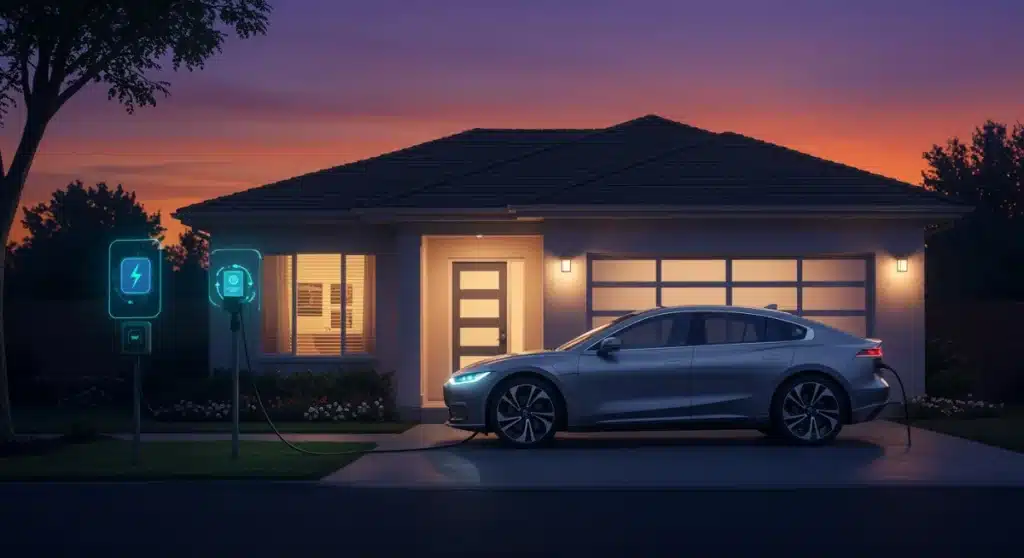
Vehicle-to-Grid (V2G) technology is poised to revolutionize home energy consumption for US electric vehicle owners by 2026, potentially yielding a significant 20% reduction in their household electricity bills.
The future of energy is dynamic, and at its heart lies the electric vehicle. By 2026, the promise of V2G home energy savings is set to become a tangible reality for many US EV owners, offering a compelling opportunity to cut household electricity costs by an impressive 20%. This isn’t just about charging your car; it’s about your car actively participating in your home’s energy ecosystem and the broader grid, transforming from a mere consumer to a powerful, flexible energy asset.
Understanding Vehicle-to-Grid (V2G) Technology
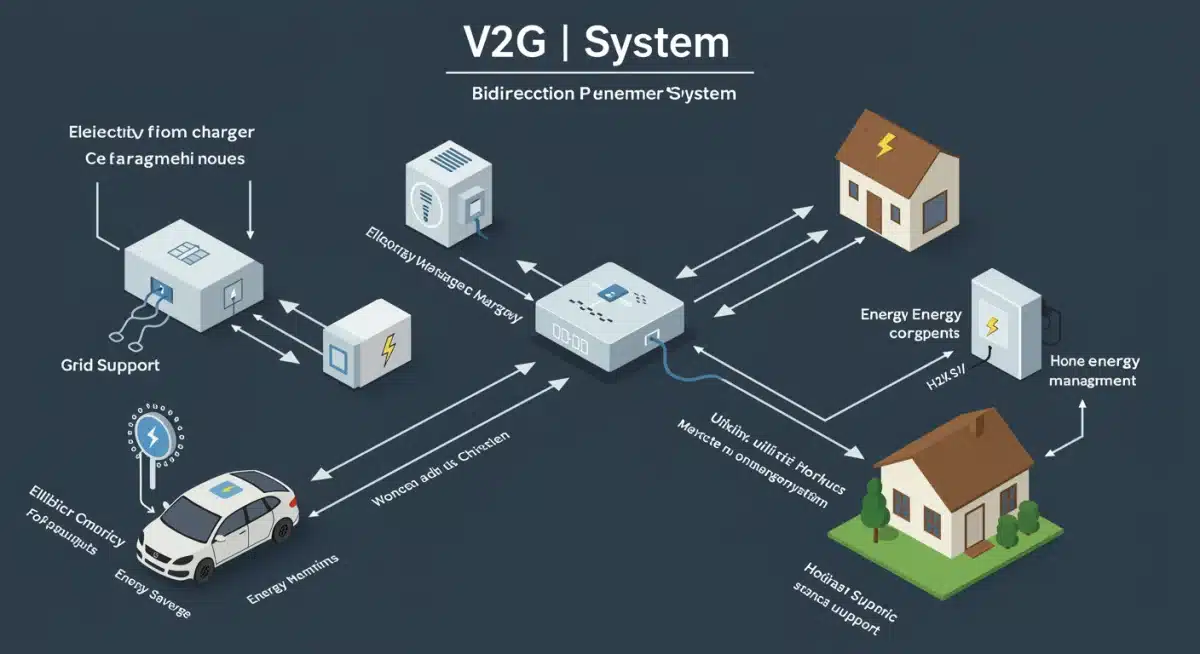
Vehicle-to-Grid, or V2G, represents a paradigm shift in how we view electric vehicles. No longer are EVs solely considered transportation devices; they are becoming mobile energy storage units capable of both drawing power from and supplying power back to the electrical grid. This bidirectional energy flow is the cornerstone of V2G, enabling a symbiotic relationship between your EV, your home, and the utility company.
In essence, V2G allows your electric vehicle’s battery to serve as a flexible energy reservoir. When electricity prices are low or renewable energy generation is high, your EV can charge. Conversely, during periods of peak demand or when electricity prices skyrocket, your EV can discharge a portion of its stored energy back into your home or the grid, earning you credits or reducing your consumption from expensive sources.
The Mechanics of Bidirectional Charging
The core technology enabling V2G is the bidirectional charger. Unlike conventional EV chargers that only allow electricity to flow in one direction (from grid to car), bidirectional chargers are designed to manage power flow in both directions. This advanced hardware, coupled with sophisticated software, orchestrates the charging and discharging cycles based on various factors.
- Bidirectional Charger: This specialized equipment converts AC power from the grid to DC for the EV battery and vice versa, facilitating two-way energy transfer.
- Smart Energy Management System: Software that communicates with the grid, your home’s energy needs, and your EV to optimize charging and discharging schedules.
- Communication Protocols: Standards like ISO 15118 allow the EV, charger, and grid to exchange information securely and efficiently.
The seamless integration of these components ensures that your EV’s battery is utilized effectively without compromising its longevity or your daily transportation needs. The technology is rapidly maturing, making V2G a viable and increasingly attractive option for EV owners looking to maximize their vehicle’s utility beyond just driving.
In summary, V2G transforms your EV into an active participant in energy management, offering flexibility and potential financial benefits through its ability to store and release electricity. This foundational understanding is crucial for appreciating the broader impact V2G will have on home energy consumption.
The Economic Promise: 20% Home Energy Cost Reduction
The most compelling aspect of V2G for US EV owners in 2026 is the tangible economic benefit: a projected 20% reduction in home energy costs. This significant saving isn’t a mere hypothetical; it’s based on evolving energy markets, smart grid advancements, and the increasing capacity of EV batteries. The economic model behind this reduction is multifaceted, leveraging arbitrage and demand response mechanisms.
Imagine being able to power your home during expensive peak hours using electricity stored in your EV when it was charged during cheaper off-peak times. This strategic energy management directly translates into lower utility bills. Furthermore, some utility companies are beginning to offer incentives for EV owners who participate in V2G programs, further sweetening the deal.
Arbitrage and Demand Response with V2G
V2G enables two primary economic strategies for saving money:
- Energy Arbitrage: This involves buying electricity when prices are low (e.g., overnight, when renewable generation is abundant) and selling or using it when prices are high (e.g., during evening peak demand). Your EV battery acts as a temporary storage unit, allowing you to capitalize on price fluctuations.
- Demand Response: Utility companies often offer programs that provide financial incentives for reducing electricity consumption during periods of high grid stress. With V2G, your EV can either supply power to your home or back to the grid during these events, helping to stabilize the grid while earning you credits or payments.
These strategies are becoming more accessible as smart grid technologies improve and as more utilities recognize the value of distributed energy resources like EVs. The 20% saving is an average projection, and actual savings could vary based on local electricity rates, utility programs, and individual energy consumption patterns. However, the potential for substantial savings is undeniable.
The integration of V2G with home solar systems further amplifies these savings. During sunny days, excess solar energy can be stored in your EV, providing a backup power source for your home at night or during cloudy periods, reducing reliance on the grid and maximizing self-sufficiency.
In conclusion, the economic benefits of V2G are a major driver for its adoption. By intelligently managing energy flow, EV owners can transform their vehicles into powerful tools for financial savings, making EV ownership even more attractive in the coming years.
Technological Readiness and Infrastructure in 2026
By 2026, the technological landscape for V2G is expected to be significantly more mature and accessible. While the core technology for bidirectional charging exists today, widespread adoption requires robust infrastructure, standardized protocols, and a supportive regulatory environment. Significant progress is being made on all these fronts across the United States.
Automakers are increasingly designing EVs with V2G capabilities in mind, and charger manufacturers are scaling up production of bidirectional units. Furthermore, pilot projects and research initiatives are paving the way for larger-scale deployments, addressing technical challenges and refining operational models. The goal is to make V2G as seamless and user-friendly as possible.

Key Developments Driving V2G Readiness
Several key areas are seeing rapid development:
- Standardization: Industry efforts are focusing on establishing universal communication protocols (like ISO 15118-20) to ensure interoperability between different EVs, chargers, and grid systems.
- Bidirectional Charger Availability: More manufacturers are entering the market, leading to increased availability and competitive pricing for home and commercial bidirectional chargers.
- Utility Integration: Grid operators and utility companies are actively developing programs and infrastructure to integrate V2G resources, recognizing their value for grid stability and renewable energy integration.
The regulatory framework is also evolving to support V2G. Government incentives, pilot programs, and policy changes are encouraging both consumers and utilities to embrace this technology. As more EVs with V2G capabilities hit the market, and as the supporting infrastructure becomes more robust, the path to achieving those 20% home energy savings becomes clearer.
Challenges remain, particularly concerning cybersecurity and the complexity of managing a distributed energy network. However, continuous innovation and collaborative efforts across the automotive and energy sectors are addressing these hurdles, ensuring V2G’s secure and efficient deployment.
In conclusion, 2026 marks a critical juncture for V2G, with technological advancements and infrastructural developments converging to make it a practical and beneficial reality for a growing number of EV owners.
Impact on EV Battery Health and Longevity
A common concern among EV owners regarding V2G technology is its potential impact on battery health and longevity. It’s a valid question, as battery degradation is a natural process influenced by charging cycles, depth of discharge, and temperature. However, modern V2G systems are designed with sophisticated battery management strategies to mitigate these concerns.
The goal is not to excessively cycle the battery but to use its existing capacity intelligently. V2G transactions typically involve shallow discharges, meaning only a small percentage of the battery’s total capacity is used for grid services. This approach minimizes stress on the battery and aligns with best practices for extending battery life.
Smart Battery Management Systems
Advanced battery management systems (BMS) play a crucial role in protecting EV batteries during V2G operations:
- Optimized Charging/Discharging: The BMS ensures that charging and discharging occurs within optimal temperature ranges and state-of-charge windows, avoiding extreme conditions that accelerate degradation.
- Shallow Cycling: V2G systems are programmed to utilize only a fraction of the battery’s capacity for grid services, often between 20-80% state of charge, which is considered the ‘sweet spot’ for battery longevity.
- Degradation Monitoring: The BMS continuously monitors battery health, adjusting V2G participation to ensure the battery remains within its warranty parameters and expected lifespan.
Furthermore, many V2G programs will include guarantees or insurance for battery degradation, providing peace of mind to EV owners. The financial incentives and energy savings offered by V2G are designed to outweigh any minimal, carefully managed impact on battery life, often by extending the vehicle’s overall economic value.
Research and real-world pilot programs consistently show that with proper management, V2G participation does not significantly accelerate battery degradation beyond what would occur with normal driving and charging. In some cases, smart charging (a component of V2G) can even optimize battery health by avoiding prolonged periods at 100% or 0% charge.
Therefore, while battery health remains a key consideration, the industry is developing robust solutions to ensure V2G benefits can be realized without undue concern for the longevity of the EV’s most valuable component. The balance between utility and preservation is meticulously engineered.
Government Incentives and Utility Programs
The widespread adoption of V2G technology in the US by 2026 will be significantly propelled by supportive government incentives and innovative utility programs. Recognizing the immense potential of V2G for grid stability, renewable energy integration, and consumer benefits, federal, state, and local entities are actively creating frameworks to encourage participation.
These incentives often come in various forms, including tax credits for bidirectional charger installations, rebates for V2G-enabled EVs, and direct payments for grid services provided by EV owners. Utility companies, in particular, are at the forefront of developing programs that integrate V2G into their demand-side management strategies, offering financial rewards for participation.
Examples of Emerging Programs and Policies
While specific programs vary by state and utility, common themes are emerging:
- Federal Tax Credits: Expect continued or expanded federal tax credits for eligible V2G charging equipment, making the initial investment more affordable for homeowners.
- State-Level Rebates: Many states are offering their own rebates or incentives for smart charging infrastructure, including those with V2G capabilities, aligning with state-level clean energy goals.
- Utility Demand Response Programs: Utilities are rolling out programs that pay EV owners to discharge power during peak demand. These payments, often in the form of bill credits, directly contribute to the 20% home energy savings.
- “Virtual Power Plant” Initiatives: Some utilities are aggregating V2G-enabled EVs into virtual power plants, allowing them to collectively provide grid services and earn revenue for their owners.
These programs are not just about reducing consumer costs; they are vital for modernizing the grid, making it more resilient and accommodating to intermittent renewable energy sources like solar and wind. By empowering EV owners to become active participants in the energy market, these initiatives foster a more decentralized and sustainable energy future.
Staying informed about local and federal incentives will be crucial for EV owners looking to maximize their V2G benefits. The landscape of these programs is dynamic, but the trend clearly points towards increasing support for V2G as a key component of future energy infrastructure.
Challenges and Future Outlook for V2G in the US
While the prospects for V2G in the US by 2026 are overwhelmingly positive, several challenges need to be addressed to ensure its seamless and widespread adoption. These hurdles range from technical complexities and regulatory harmonization to consumer education and market penetration. Overcoming these will be key to unlocking the full potential of V2G technology.
One significant challenge is the need for greater interoperability. With various EV manufacturers, charger providers, and utility systems, ensuring that all components can communicate effectively and securely is paramount. Furthermore, cybersecurity concerns are ever-present, as V2G systems involve sensitive energy infrastructure.
Overcoming Obstacles to Widespread V2G Adoption
Addressing these challenges requires a multi-faceted approach:
- Standardization and Interoperability: Continued collaboration between industry stakeholders, government bodies, and standards organizations is essential to create a unified V2G ecosystem.
- Cybersecurity Measures: Robust security protocols and continuous monitoring will be vital to protect V2G infrastructure from cyber threats and ensure grid stability.
- Consumer Awareness and Education: Educating EV owners about the benefits, functionality, and ease of V2G participation is crucial for driving adoption. Many consumers are still unfamiliar with the concept.
- Regulatory Frameworks: Harmonizing regulations across different states and utility service areas will streamline V2G deployment and ensure fair compensation for participants.
Despite these challenges, the future outlook for V2G in the US is bright. The economic and environmental benefits are too significant to ignore. As renewable energy sources become more prevalent, the need for flexible energy storage and grid balancing services will only increase, positioning V2G-enabled EVs as invaluable assets. Continuous innovation in battery technology, smart grid solutions, and policy support will further accelerate its growth.
By 2026, V2G is expected to transition from a niche technology to a mainstream feature for many EV owners, fundamentally altering how we interact with our vehicles and the energy grid. The journey involves overcoming technical and regulatory hurdles, but the destination—a more resilient, efficient, and cost-effective energy system—is well within reach.
Preparing Your Home and EV for V2G
As 2026 approaches, EV owners in the US can begin preparing to take advantage of V2G technology and its potential for 20% home energy savings. While the full suite of V2G services might not be immediately available in all areas, understanding the prerequisites and potential upgrades will position you to be an early adopter and reap the benefits as they emerge.
The first step is often evaluating your current EV and home charging setup. Not all electric vehicles are V2G-compatible, and a bidirectional charger is a fundamental requirement. Beyond the hardware, integrating a home energy management system (HEMS) can significantly enhance your ability to optimize V2G operations and maximize savings.
Essential Steps for V2G Readiness
Consider these actions to prepare for V2G:
- Check EV Compatibility: Research whether your current or next EV model supports V2G capabilities. Many newer models are being designed with this in mind.
- Install a Bidirectional Charger: This is the most crucial piece of equipment. Consult with certified electricians and V2G providers to ensure proper installation and compatibility with your home’s electrical system.
- Consider a Home Energy Management System (HEMS): A HEMS can integrate your V2G charger with other smart home devices, solar panels, and energy usage data, allowing for more intelligent energy arbitrage and demand response.
- Engage with Your Utility: Contact your local utility provider to inquire about their V2G programs, incentives, and interconnection requirements. Participation in pilot programs can offer early benefits.
Beyond the technical aspects, understanding your household’s energy consumption patterns is also beneficial. Knowing when your home uses the most electricity and when electricity rates are highest will help you schedule V2G activities to achieve maximum savings. Software applications and smart meters can provide valuable insights into your energy usage.
Preparing for V2G is an investment, but the projected long-term savings and contributions to a more sustainable energy grid make it a worthwhile endeavor. As the technology matures and becomes more accessible, early preparation will ensure you are ready to integrate your EV into your home’s energy future, driving both sustainability and significant cost reductions.
| Key Point | Brief Description |
|---|---|
| V2G Core Concept | Electric vehicles capable of both drawing and supplying power to the grid, acting as mobile energy storage. |
| 20% Energy Savings | Projected reduction in home energy costs for US EV owners by 2026 through V2G participation. |
| Technological Readiness | Maturing bidirectional chargers, improving standards, and increasing EV compatibility by 2026. |
| Battery Health | Sophisticated BMS and shallow cycling minimize degradation, ensuring V2G is safe for EV batteries. |
Frequently Asked Questions About V2G
V2G technology enables electric vehicles (EVs) to not only draw power from the grid for charging but also to send electricity back to the grid or directly to a home. This bidirectional energy flow allows EVs to act as flexible energy storage units, supporting grid stability and potentially reducing energy costs for owners.
V2G can reduce costs by allowing you to charge your EV when electricity prices are low (off-peak) and then discharge that stored energy to power your home when prices are high (on-peak). This energy arbitrage, combined with potential utility incentives for grid support, can lead to significant savings, estimated at up to 20% by 2026.
Modern V2G systems are designed with advanced battery management systems (BMS) that minimize impact on battery health. They typically use shallow discharge cycles and operate within optimal state-of-charge windows, mitigating degradation. Research indicates that with proper management, V2G participation does not significantly shorten battery lifespan compared to regular use.
To enable V2G at home, you will need a V2G-compatible electric vehicle and a bidirectional charging station. Additionally, integrating a home energy management system (HEMS) can optimize energy flow between your EV, home, and the grid, maximizing your savings and energy independence.
Yes, both federal and state governments, along with various utility companies, are increasingly offering incentives for V2G adoption. These can include tax credits for bidirectional chargers, rebates for V2G-enabled vehicles, and payments for participating in utility demand response programs. It’s advisable to check local and federal programs for current opportunities.
Conclusion
The journey towards widespread V2G home energy savings by 2026 represents a significant leap forward in sustainable living and smart energy management for US EV owners. The convergence of technological advancements, supportive policies, and increasing consumer awareness is paving the way for a future where electric vehicles are not just a mode of transport but integral components of a resilient and cost-effective energy ecosystem. The projected 20% reduction in home energy costs underscores the profound economic impact this technology will have, transforming liabilities into assets and empowering individuals to take control of their energy consumption. While challenges remain, the clear benefits ensure that V2G will be a defining feature of the automotive and energy landscapes in the years to come, offering a greener, more economical path for millions of households.