2026 Autonomous Driving Features: Top U.S. Vehicles Unpacked
The 2026 autonomous driving features are set to redefine the automotive landscape, with several top U.S. vehicles integrating advanced capabilities for enhanced safety, convenience, and efficiency on our roads.
Welcome to an insider look: dissecting the 2026 autonomous driving features in four top-tier U.S. vehicles. As we fast approach the mid-decade mark, the promise of self-driving cars is no longer a distant dream but a tangible reality transforming our daily commutes and long-distance journeys. This article dives deep into the technological marvels that define the next generation of automotive intelligence, offering a glimpse into a future where vehicles navigate with unprecedented precision and safety.
The evolution of autonomous driving technology
Autonomous driving technology has undergone a remarkable evolution, transitioning from rudimentary driver-assistance systems to sophisticated, AI-powered platforms. In 2026, the landscape is dominated by advanced Level 2+ and Level 3 systems, pushing closer to fully autonomous Level 4 capabilities. These advancements are driven by a combination of powerful processors, enhanced sensor suites, and increasingly refined artificial intelligence algorithms.
Early iterations of autonomous technology primarily focused on single-task automation, such as adaptive cruise control or lane-keeping assist. While groundbreaking at the time, these systems still required constant driver supervision. The 2026 models, however, integrate these functions seamlessly, allowing for more extended periods of hands-free operation under specific conditions. This shift represents a significant leap in trust and capability, moving from assistance to genuine autonomy.
Key technological pillars
- Advanced Sensor Fusion: Combining data from lidar, radar, cameras, and ultrasonic sensors for a comprehensive environmental understanding.
- High-Definition Mapping: Utilizing detailed, real-time maps to provide precise localization and predict road conditions.
- Artificial Intelligence and Machine Learning: Enabling vehicles to learn from diverse driving scenarios and adapt to complex situations.
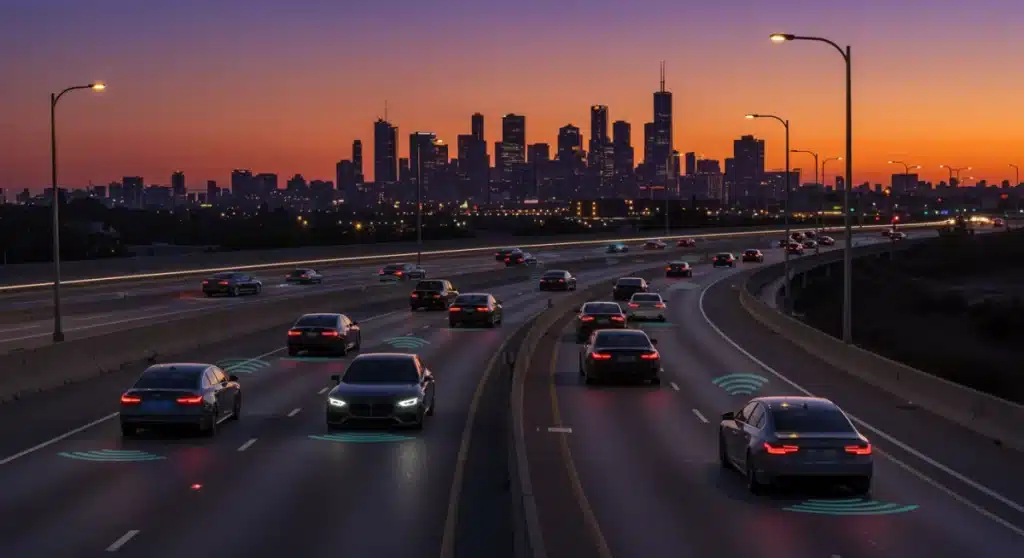
- Vehicle-to-Everything (V2X) Communication: Allowing cars to communicate with other vehicles, infrastructure, and even pedestrians for enhanced awareness.
The continuous development in these areas ensures that the 2026 autonomous driving features are not just innovative but also robust and reliable. This holistic approach to perception and decision-making is what sets the current generation apart from its predecessors, paving the way for even greater autonomy in the years to come. The emphasis remains on safety, with redundant systems and rigorous testing protocols in place to ensure passenger well-being.
Cadillac Celestiq: luxury meets level 3 autonomy
The 2026 Cadillac Celestiq stands as a testament to American luxury and technological prowess, integrating a highly sophisticated Level 3 autonomous driving system. This ultra-luxury electric vehicle is designed to offer an unparalleled driving experience, where human input becomes optional in specific, geofenced environments. The Celestiq’s system, an evolution of GM’s Super Cruise, is expected to provide hands-free, eyes-off driving on compatible highways, allowing occupants to engage in other activities.
What sets the Celestiq apart is its meticulous attention to detail in integrating these features. The autonomous system isn’t merely an add-on; it’s an intrinsic part of the vehicle’s design, from its advanced sensor placement to its intuitive user interface. Cadillac aims to deliver a seamless transition between human-driven and autonomous modes, ensuring that the driving experience remains fluid and confidence-inspiring.
Celestiq’s autonomous highlights
- Enhanced Super Cruise: Building upon an already robust system, the Celestiq’s Super Cruise will offer expanded road network compatibility and improved performance in various weather conditions.
- Ultra-High-Definition Mapping: Leveraging an extensive network of precise maps to guide the vehicle with centimeter-level accuracy.
- Driver Attention System: An advanced camera-based system that monitors driver attentiveness, ensuring readiness to take over when necessary.
The Celestiq’s approach to autonomous driving emphasizes not just functionality but also the overall luxury experience. The system is designed to reduce driver fatigue on long journeys, making travel more comfortable and allowing occupants to truly relax and enjoy the opulent interior. This blend of cutting-edge technology and premium comfort positions the Celestiq as a frontrunner in the luxury autonomous segment.
Ford F-150 Lightning: self-driving for the working truck
The Ford F-150 Lightning, a pioneer in the electric truck market, is set to further revolutionize its capabilities with advanced 2026 autonomous driving features. Ford’s BlueCruise system, already a strong contender in the Level 2+ category, is anticipated to evolve significantly, offering more comprehensive hands-free driving on an expanded network of pre-qualified highways. This integration aims to enhance productivity and reduce fatigue for truck owners who often spend long hours on the road.
For a vehicle designed for utility and work, autonomous driving features bring a unique set of benefits. Imagine a contractor being able to review blueprints or make calls while the truck handles the highway commute, or a family on a road trip enjoying more relaxed travel. The F-150 Lightning’s system is being developed with the diverse needs of its user base in mind, focusing on reliability and practicality in various real-world scenarios.
Ford’s commitment to continuous improvement means that the 2026 F-150 Lightning will likely feature more robust sensor arrays and improved software, allowing for smoother lane changes, better navigation through construction zones, and enhanced predictive capabilities. The goal is to make autonomous driving an indispensable tool for both work and leisure.
BlueCruise enhancements
- Expanded Hands-Free Zones: Significant increase in compatible road miles across the U.S., allowing for more frequent hands-free operation.
- Predictive Lane Keeping: Advanced algorithms to anticipate road curvature and traffic flow, optimizing lane positioning.
- Trailer Tow Assist Integration: Potential for autonomous assistance even when towing, a crucial feature for truck users.
The F-150 Lightning’s integration of advanced autonomous features underscores Ford’s vision of a future where even the most rugged vehicles can offer sophisticated driving assistance. This ensures that the benefits of autonomous technology are not limited to luxury sedans but are accessible across a wider range of vehicle types, serving a broader audience.
Tesla Model S: pushing the boundaries of full self-driving
Tesla has long been at the forefront of autonomous driving, and the 2026 Model S is expected to continue pushing the boundaries with its enhanced Full Self-Driving (FSD) capabilities. While still operating as a Level 2+ system requiring driver supervision, Tesla’s FSD aims for a higher degree of autonomy than many competitors, including complex urban driving, traffic light and stop sign recognition, and automatic parking.
The unique aspect of Tesla’s approach is its reliance primarily on cameras and neural networks. This vision-only strategy, constantly refined through vast amounts of real-world driving data, allows for rapid iteration and deployment of new features via over-the-air updates. By 2026, the FSD software is anticipated to be significantly more robust, capable of navigating even more intricate driving scenarios with greater confidence and fewer interventions.
Tesla’s commitment to a learning neural network means that every mile driven by a Tesla vehicle contributes to the improvement of the FSD system. This continuous feedback loop ensures that the software is constantly evolving, adapting to new road conditions, and learning from challenging situations. The 2026 Model S will showcase the culmination of years of this iterative development.
FSD advancements
- Improved Urban Navigation: More reliable handling of complex intersections, unprotected turns, and pedestrian interactions.
- Enhanced Object Recognition: Greater accuracy in identifying and categorizing various road users and obstacles.
- Predictive Behavior Modeling: Better anticipation of other drivers’ and pedestrians’ actions for safer maneuvering.
The vision for the 2026 Model S is to provide a near-fully autonomous experience, where the driver’s role is largely supervisory, ready to intervene only in rare, extreme circumstances. This ongoing pursuit of full autonomy positions Tesla as a key player in shaping the future of self-driving technology.
Rivian R1S: adventure with intelligent autonomy
The 2026 Rivian R1S, an all-electric SUV designed for adventure, is poised to incorporate significant advancements in autonomous driving features, blending rugged capability with intelligent driving assistance. Rivian’s approach focuses on a system that not only excels on highways but also provides robust support in less predictable environments, such as unpaved roads or challenging weather conditions. This makes it particularly appealing to outdoor enthusiasts who desire both exploration and cutting-edge technology.
Rivian’s autonomous system, dubbed Driver+, is expected to evolve into a more comprehensive Level 2+ offering by 2026. This means hands-free driving on compatible roads, with enhanced capabilities for adaptive cruise control, lane-keeping, and automatic lane changes. The R1S will leverage its robust sensor suite, including multiple cameras, radar, and ultrasonic sensors, to create a detailed 360-degree view of its surroundings, crucial for both on-road and off-road safety.
R1S Driver+ evolution
- Off-Road Assist: Potential for guided off-road driving modes, assisting with challenging terrain and obstacles.
- Enhanced Environmental Perception: Improved performance in adverse conditions like heavy rain, snow, or fog, critical for adventure vehicles.
- Integrated Navigation: Seamless integration of autonomous features with the vehicle’s navigation system for optimized route planning and execution.
The R1S aims to provide a reassuring and capable driving partner, whether navigating city streets or traversing remote landscapes. The 2026 autonomous driving features will allow drivers to focus more on the journey and less on the mundane aspects of driving, enhancing the overall adventure experience while maintaining a high level of safety and control.
The impact of 2026 autonomous driving features on safety and convenience
The widespread adoption of 2026 autonomous driving features is poised to have a transformative impact on both road safety and driver convenience. From a safety perspective, these systems are designed to significantly reduce human error, which is a leading cause of accidents. Advanced sensors, faster processing, and predictive algorithms allow autonomous vehicles to react more quickly and consistently than human drivers, potentially preventing collisions and mitigating their severity.
Convenience is another major beneficiary. Imagine reclaiming commute time for work, entertainment, or relaxation, rather than being stuck in traffic. Autonomous features free up mental bandwidth, making long drives less fatiguing and more enjoyable. They also promise to improve traffic flow by optimizing speeds and spacing between vehicles, leading to less congestion and reduced fuel consumption, or improved battery efficiency for EVs.
Societal benefits
- Reduced Accidents: Lower rates of collisions due to minimized human error and faster reaction times.
- Increased Accessibility: Greater mobility for individuals who cannot drive, such as the elderly or those with disabilities.
- Optimized Traffic Flow: Smoother, more efficient traffic movement, leading to less congestion and quicker travel times.
- Environmental Benefits: Potential for reduced emissions and better energy efficiency through optimized driving patterns.
The integration of V2X communication further enhances these benefits by creating a network of interconnected vehicles and infrastructure. This allows for real-time sharing of information about road conditions, hazards, and traffic patterns, enabling autonomous systems to make even more informed decisions. The collective intelligence of these interconnected systems paves the way for a safer, more efficient, and more accessible transportation ecosystem.
Challenges and the road ahead for autonomous vehicles
Despite the remarkable progress, the journey towards fully ubiquitous autonomous vehicles in 2026 still faces several significant challenges. Technical hurdles, regulatory complexities, and public perception all play crucial roles in shaping the future of this technology. While Level 2+ and Level 3 systems are becoming more sophisticated, achieving true Level 4 and Level 5 autonomy in all conditions remains a formidable task.
One major technical challenge is handling unpredictable scenarios, such as extreme weather conditions, unexpected road debris, or erratic human driver behavior. Autonomous systems must be robust enough to safely navigate these situations without human intervention. Furthermore, the sheer volume of data required to train and validate these systems is immense, demanding continuous investment in AI and machine learning infrastructure.
Overcoming obstacles
- Regulatory Harmonization: Developing consistent and clear legal frameworks across different states and nations to govern autonomous vehicle operation.
- Public Trust and Acceptance: Educating the public about the safety and benefits of autonomous technology to overcome skepticism and foster adoption.
- Cybersecurity: Ensuring the robust protection of autonomous systems against hacking and cyber threats, which could compromise safety.
- Infrastructure Adaptation: The need for smart city infrastructure that can communicate effectively with autonomous vehicles, enhancing their capabilities.
The road ahead for autonomous vehicles is one of continuous innovation and collaboration. Manufacturers, regulators, and infrastructure developers must work in concert to address these challenges, ensuring that the promise of a safer, more efficient, and more convenient transportation future becomes a widespread reality. The advancements seen in the 2026 models are crucial steps on this path, but the journey is far from over.
| Key Feature | Brief Description |
|---|---|
| Level 3 Autonomy | Vehicles can handle most driving tasks under specific conditions, requiring driver readiness for intervention. |
| Advanced Sensor Fusion | Integration of lidar, radar, cameras, and ultrasound for comprehensive environmental perception. |
| AI and Machine Learning | Enabling vehicles to learn, adapt, and make complex decisions in dynamic driving situations. |
| V2X Communication | Vehicle-to-everything communication for enhanced awareness and coordination with surroundings. |
Frequently asked questions about 2026 autonomous driving
Level 2 systems provide driver assistance for steering, acceleration, and braking but require constant driver supervision. Level 3 allows the driver to disengage from driving tasks under specific conditions, though they must be ready to take over when prompted by the system.
Many 2026 autonomous features, especially Level 3, are designed for specific, geofenced highways and well-mapped routes. While advancements improve performance in varied conditions, full autonomy on all road types and in all weather remains a future goal, requiring driver readiness.
Autonomous vehicles use a combination of sensors, including cameras, radar, lidar, and ultrasonic sensors. Data from these sensors is fused and processed by AI algorithms to create a comprehensive, real-time understanding of the vehicle’s environment.
V2X (Vehicle-to-Everything) communication allows autonomous cars to exchange information with other vehicles, infrastructure, and pedestrians. This enhances situational awareness, enabling predictive decisions and improving overall road safety and traffic efficiency.
Yes, cybersecurity is a paramount concern for autonomous vehicle developers. Manufacturers are implementing robust encryption, secure software updates, and intrusion detection systems to protect against potential hacking and ensure the integrity and safety of these advanced automotive systems.
Conclusion
The 2026 autonomous driving features in top U.S. vehicles represent a compelling leap forward in automotive technology. From Cadillac’s luxurious Level 3 experience to Ford’s practical applications for truck owners, Tesla’s vision-only advancements, and Rivian’s intelligent adventure capabilities, the landscape of driving is undeniably changing. While challenges remain in regulatory frameworks and public acceptance, the trajectory is clear: a future where vehicles are safer, more efficient, and offer unparalleled convenience. These innovations not only redefine the driving experience but also set the stage for a more integrated and intelligent transportation ecosystem.